Last day of spring, heat is getting ready to roll into Ontario, and I have the urge to knit. A scarf. One elegant and masculine enough to wear to a Manhattan office without looking too much like "my girlfriend got bored and made me wear this".
Picked up 2 skeins of Bernat Cashmere in colour "coal" and a pair of size 9 (5.5 mm) bamboo needles. Finding a pattern I liked took longer. I finally settled for a modified basketweave from "60 Easy-To-Knit Pattern Stitches Combine to Create Sampler Afghans". It goes like this:
- cast on desired number of stitches divisible by 8 (I'm using 32)
1: knit
2: K5, P3
3. K3, P5
4. K5, P3
5: knit
6: P5, K3
7: P3, K5
8: P5, K3
The pattern is easy enough to track while watching PBS, patterny enough to not be boring, and subtle enough (especially in a dark colour) to wear with a suit.
Saturday, June 20, 2009


Monday, June 8, 2009
Hainburg
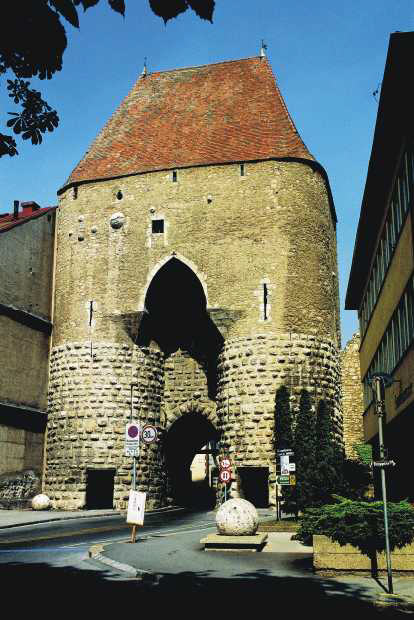
The prettiest village on the road from Vienna to Bratislava is Hainburg. When taking the bus to the Vienna airport, one does wonder if the bus is going to make it through the Weinertor.
On the way back to Bratislava we stopped to walk through the village. Most of the shops and restaurants were closed for Sunday, but we found an old courtyard that was serving pop and snacks. We ordered what we thought was buttered bread for 1 euro and bread with ham for 3 euro. The buttered bread came with about half a pound of cheese and the bread with ham had an equal amount of ham. I was reminded that Austrians like to eat and that price is not an indication of size. Heavily fortified, we checked out the Weinertor, then walked to the other end of town to see its gate. We followed a street that ran parallel to the wall to get a better look at the castle. This view of the castle gate is behind the local high school. Down the street is the town pranger, a reminder of penal days gone by.
On the way back to Bratislava we stopped to walk through the village. Most of the shops and restaurants were closed for Sunday, but we found an old courtyard that was serving pop and snacks. We ordered what we thought was buttered bread for 1 euro and bread with ham for 3 euro. The buttered bread came with about half a pound of cheese and the bread with ham had an equal amount of ham. I was reminded that Austrians like to eat and that price is not an indication of size. Heavily fortified, we checked out the Weinertor, then walked to the other end of town to see its gate. We followed a street that ran parallel to the wall to get a better look at the castle. This view of the castle gate is behind the local high school. Down the street is the town pranger, a reminder of penal days gone by.
Carnuntum
On the road half-way between Vienna and Bratislava is an old looking arch. It is the remains of the Heidentor (heathen gate), erected between 354 and 361 AD as a triumphal monument for Emperor Constantius II. The gate is part of the Carnuntum, a significant Roman fortification founded in 6 AD by Tiberius.
And, as luck would have it, the day we had planned to tour the Austrian countryside and figure out what the heck that arch was happened to fall during The Big Carnuntum Roman Festival. So, we headed out on the B9 to Petronell-Carnuntum, following the well-marked signs on the highway. After parking in a field, we paid 9 euro to get in.
The size of the archaeological site is impressive and well worth visiting anytime. There are plans to excavate and restore portions of the site to its former glory through 2011. There are plaques in English and German to explain the site plan, the Roman sewage, plumbing, and heating systems, and the types of buildings. Some of the houses have been restored and provide a glimpse into the high standard of living available in Roman times.
For the festival, the grounds were strewn with souvenir stalls and demonstrations of weaving, forgery, tinsmithing, pottery, cooking, etc. There were places for children to make their own sword and shield or clay seal. Quite a few people were dressed in togas or legion costumes.
There were different military demonstrations every hour. We watched an entertaining demonstration of a legion training 2 new recruits in the art of using their shield and spear. The fair was very busy but well organized. The lineups for the water closets were short and the tables and garbage were kept quickly cleared to give everyone a chance to eat.
We then went in search of the arch. We quickly discovered that while you can clearly see the arch from the highway, you can't get to it from there. After driving around Petronell-Carnuntum a few times we remembered that the magic word was "Heidentor" and quickly found that nearly every side street in town had a brown sign pointing towards it. Ah yes, all roads lead to Rome...
And, as luck would have it, the day we had planned to tour the Austrian countryside and figure out what the heck that arch was happened to fall during The Big Carnuntum Roman Festival. So, we headed out on the B9 to Petronell-Carnuntum, following the well-marked signs on the highway. After parking in a field, we paid 9 euro to get in.
The size of the archaeological site is impressive and well worth visiting anytime. There are plans to excavate and restore portions of the site to its former glory through 2011. There are plaques in English and German to explain the site plan, the Roman sewage, plumbing, and heating systems, and the types of buildings. Some of the houses have been restored and provide a glimpse into the high standard of living available in Roman times.
For the festival, the grounds were strewn with souvenir stalls and demonstrations of weaving, forgery, tinsmithing, pottery, cooking, etc. There were places for children to make their own sword and shield or clay seal. Quite a few people were dressed in togas or legion costumes.
There were different military demonstrations every hour. We watched an entertaining demonstration of a legion training 2 new recruits in the art of using their shield and spear. The fair was very busy but well organized. The lineups for the water closets were short and the tables and garbage were kept quickly cleared to give everyone a chance to eat.
We then went in search of the arch. We quickly discovered that while you can clearly see the arch from the highway, you can't get to it from there. After driving around Petronell-Carnuntum a few times we remembered that the magic word was "Heidentor" and quickly found that nearly every side street in town had a brown sign pointing towards it. Ah yes, all roads lead to Rome...
Driny Cave
The road to Driny Cave is also well marked with signs starting just before the town of Smolenice. Parking costs 2 euro. You then walk uphill, at a fairly steep grade, for about 20 minutes to access the entrance to the cave. AFAIK, the tour is only in Slovakian (ours was)--you purchase your ticket at the little store at the cave entrance for 5 euro.
The cave itself is spectacular. The path through the cave is paved, a surprising convenience seeing that the entire tour is walking, even the descent into the deeper parts of the cave. Spot lighting has been designed to show off the nicest features and the colours range through various shades of pale pink to orange. While the guide only spoke Slovakian, he gave ample time for viewing the various stops. Some sections were surprisingly narrow and a few spots will require a tall person to watch their head and shoulders.
Most of the formations are stalagmite with Majko's Hall making quite a valley of the phallus. The elephant's ears were an interesting formation. There were also drip formations that resembled tangled roots made from melted wax.
The cave itself is spectacular. The path through the cave is paved, a surprising convenience seeing that the entire tour is walking, even the descent into the deeper parts of the cave. Spot lighting has been designed to show off the nicest features and the colours range through various shades of pale pink to orange. While the guide only spoke Slovakian, he gave ample time for viewing the various stops. Some sections were surprisingly narrow and a few spots will require a tall person to watch their head and shoulders.
Most of the formations are stalagmite with Majko's Hall making quite a valley of the phallus. The elephant's ears were an interesting formation. There were also drip formations that resembled tangled roots made from melted wax.
Červený Kameň
The road to Červený Kameň is well marked. You'll see the castle itself a few minutes before the sign. The road takes you up a mountain and through thickly wooded forest before opening up into a free parking lot next to free (and clean) water closets.
The entire estate is very well maintained: well manicured lawns and gardens with roaming peacocks, clean outbuildings, non-crumbling walls and gates, and a very large castle. There are several places to purchase a snack and a former watch tower houses a small souvenir shop.
Our first stop was the Astur falconry which offers a live show for 4 euro. The falconry has a large variety of owls, hawks, falcons, eagles, and a raven in its collection. The live show was fun with the handlers guiding (and sometimes trying to guide) a great horned owl, raven, peregrine falcon, bald eagle, and a hawk over the heads of audience members. The most impressive flyby was the Steppe eagle which flew down from the castle tower. Its wing span was easily 5 feet.
We then made our way up to the castle. The view from the tower gave an impressive paranoma of the Little Carpathians and some flatlands to the northeast. We could have paid a few euro for a 75 minute tour of the castle museum but had other sights we wanted to see that day. The museum is supposed to be quite nice, though.
There was one wedding party at the castle, one of three weddings we saw that day. Another was at Devin castle, and the most entertaining was in one of the villages we passed through--this one had a band which was leading the wedding party througout the main street of the village.
After leaving the castle, we stopped at the pizzeria in the nearby village of Casta. The garlic soup was good--nice creamy soup with lots of garlic and a bargain at 1.50 euro. When ordering pizza in Slovakia, don't let the price fool you. 2-3 people can easily eat from one 3 euro pizza as they are easily the size of a North American large pizza. Mind you, someone expecting a thick chewy crust will be disappointed as the pizza brings new meaning to the word thin crust. If you like freshly made, crispy thin crust that tastes of garlic topped with a thin amount of ingredients, you'll like Slovakian pizza.
The entire estate is very well maintained: well manicured lawns and gardens with roaming peacocks, clean outbuildings, non-crumbling walls and gates, and a very large castle. There are several places to purchase a snack and a former watch tower houses a small souvenir shop.
Our first stop was the Astur falconry which offers a live show for 4 euro. The falconry has a large variety of owls, hawks, falcons, eagles, and a raven in its collection. The live show was fun with the handlers guiding (and sometimes trying to guide) a great horned owl, raven, peregrine falcon, bald eagle, and a hawk over the heads of audience members. The most impressive flyby was the Steppe eagle which flew down from the castle tower. Its wing span was easily 5 feet.
We then made our way up to the castle. The view from the tower gave an impressive paranoma of the Little Carpathians and some flatlands to the northeast. We could have paid a few euro for a 75 minute tour of the castle museum but had other sights we wanted to see that day. The museum is supposed to be quite nice, though.
There was one wedding party at the castle, one of three weddings we saw that day. Another was at Devin castle, and the most entertaining was in one of the villages we passed through--this one had a band which was leading the wedding party througout the main street of the village.
After leaving the castle, we stopped at the pizzeria in the nearby village of Casta. The garlic soup was good--nice creamy soup with lots of garlic and a bargain at 1.50 euro. When ordering pizza in Slovakia, don't let the price fool you. 2-3 people can easily eat from one 3 euro pizza as they are easily the size of a North American large pizza. Mind you, someone expecting a thick chewy crust will be disappointed as the pizza brings new meaning to the word thin crust. If you like freshly made, crispy thin crust that tastes of garlic topped with a thin amount of ingredients, you'll like Slovakian pizza.
Slovakian Road Trip
We spent Saturday driving through the Slovakian countryside along the Little Carpathians. Route 502 took us along the Eastern slopes northwards from Bratislava to Trstn where we turned left on 51 to Jablonica where we turned south on the 501 to catch the Western slopes on the return trip to Bratislava.
Once you get used to the total absence of ditches, the roads in Western Slovakia are well maintained and, for the most part, newly paved. Once out of Bratislava, the road is 2 lanes and very busy for the first 40 km. The eastern slopes are low rolling hills and an endless stream of vineyards, punctuated by a drive through a village every 2 minutes or so. We spent some time at Červený Kameň (red rock castle) and drove up to Smolenice castle (which is only open to the public in July and August).
The narrow section between Trstn and Jablonica was deeply forested with the trees overhanging the roadway in many sections. Before turning southwards, we passed a mountain lake dotted with rental cottages and fisherman.
The western slopes were higher and more defined. The ruins of Plavecký hrad (castle) are quite impressive. Before heading into Bratislava, we took a side trip to Devin castle, making it the fourth castle we had visited within the space of an afternoon.
Some notes if you're planning a road trip:
Gas is easy to find and every village has a pizzeria and a place to buy pop or ice cream. Outside of the city, few speak English but Slovakians are friendly and can usually figure out what you want. Tourist areas are well marked, but expect any tour guides to be given in Slovakian only.
Once you get used to the total absence of ditches, the roads in Western Slovakia are well maintained and, for the most part, newly paved. Once out of Bratislava, the road is 2 lanes and very busy for the first 40 km. The eastern slopes are low rolling hills and an endless stream of vineyards, punctuated by a drive through a village every 2 minutes or so. We spent some time at Červený Kameň (red rock castle) and drove up to Smolenice castle (which is only open to the public in July and August).
The narrow section between Trstn and Jablonica was deeply forested with the trees overhanging the roadway in many sections. Before turning southwards, we passed a mountain lake dotted with rental cottages and fisherman.
The western slopes were higher and more defined. The ruins of Plavecký hrad (castle) are quite impressive. Before heading into Bratislava, we took a side trip to Devin castle, making it the fourth castle we had visited within the space of an afternoon.
Some notes if you're planning a road trip:
- book your car online about a week ahead of time
- the most reliable rent-a-cars are at the Bratislava or Vienna airports
- double-check that the car has a first aid kit and emergency triangle as these are mandatory in Slovakia
- Slovakia has a 0% blood alcohol policy so forego drinks on the days you're driving
- don't expect roads or streets to be marked--you may drive for some time before you're sure you're on the right road. Take a map, use instinct, and stick to what looks like the main road as it's probably the one you want
Gas is easy to find and every village has a pizzeria and a place to buy pop or ice cream. Outside of the city, few speak English but Slovakians are friendly and can usually figure out what you want. Tourist areas are well marked, but expect any tour guides to be given in Slovakian only.
Wednesday, May 27, 2009
A Little Havana in Bratislava
Casa del Havana is the place to be on Tuesday nights in Bratislava. Live music with no cover with each week presenting a different style. Earlier this year I was treated to Argentinian Tango which sounds much better than one might think. Last night was a nice mix of Salsa and old faves such as The Girl from Ipanema and the theme from the Godfather. The lead singer and the piano player are especially good, people actually dance, and the mojitos and Cuba Libres (rum and coke) flow freely. If you're new to Slovakia, be forewarned that the smoke gets pretty thick in the bars as everyone smokes and there aren't any smoking bans in effect. It's a bit better in the warmer weather as the windows and doors are open.
Meanwhile, the search for a package of lightbulbs continues. The major grocers, Billa and Tesco, either don't carry them or hide them very well. Ditto for the pharmacies, which up to this point have been the place to look for the supplies not found at the grocers. Other items which I have not found that fortunately fall into the "strange they don't exist but I can live without them" category are relish and sliced pickles.
Meanwhile, the search for a package of lightbulbs continues. The major grocers, Billa and Tesco, either don't carry them or hide them very well. Ditto for the pharmacies, which up to this point have been the place to look for the supplies not found at the grocers. Other items which I have not found that fortunately fall into the "strange they don't exist but I can live without them" category are relish and sliced pickles.
Subscribe to:
Posts (Atom)

 Posts
Posts